Demio is a practical option for marketing teams that want to run webinars, engage prospects and follow up on their activity. But the right platform depends on how you produce your events, involve your audience and manage the work around each session.
You may be looking for more control over the quality of the experience and audience engagement, a different approach to automated campaigns, an enterprise integration or a pricing model suited to frequent events. Those priorities do not all lead to the same platform.
These seven Demio alternatives cover those needs. We compare their published features, pricing and trade-offs so you can build a shortlist around your actual webinar program.
Features and displayed pricing reviewed on November 10, 2026, using official documentation. Supplier currencies are retained; billing commitments, taxes and temporary offers can vary.
Best Demio Alternatives at a Glance
- Sparkup: studio-quality interactive webinars with detailed audience engagement analytics.
- Livestorm: best for enterprise webinar governance and integrations.
- WebinarJam: best for sales-focused webinar presentations.
- EasyWebinar: best for evergreen funnels with integrated follow-up.
- Zoom Webinars: best for large-audience webinars in the Zoom ecosystem.
- WebinarNinja: best for a bundled webinar toolkit for small teams.
- GoTo Webinar: best for structured training and departmental webinars.
These recommendations describe different use cases, rather than an overall performance ranking. A platform can be the right choice for a recurring sales presentation and a poor fit for an interactive company event.
Why Look for a Demio Alternative?
More Control Over the Live Experience
Demio already provides polls, chat, Q&A, handouts, calls to action and attendee invitations to the stage. Looking for an alternative should start with what you want to do differently, rather than assuming those tools are missing.
For a product launch or an interactive discussion, the production workflow can matter as much as the feature list. Consider how easily a producer can arrange speakers, change layouts, introduce visual elements and keep participation connected to the video. Ask to rehearse a real session, including the transitions and audience contributions you intend to use.
A Different Automation or Team Workflow
Automated webinars are another area where the details matter: Demio supports automated and on-demand formats. An alternative needs to offer a useful difference in scheduling, follow-up, selling tools or team organization.
For example, a team building evergreen campaigns may prefer a product that combines webinar delivery, CRM follow-up and checkout. A training department may value breakout rooms or certification options. Map the full workflow before deciding that a longer feature list will solve the problem.
A Pricing Model That Matches Your Program
Demio Starter starts at $63 per month with monthly billing, or $45 per month billed annually, for 50 attendees and one host. Larger rooms and additional requirements change the comparison.
Other platforms charge by concurrent capacity, attendance credits or a selected participant allowance. A low entry price may cover a smaller room, exclude automation or require an annual commitment. Compare the plan that supports your audience, session duration, host requirements and essential features.
The 7 Best Demio Alternatives
1. Sparkup: Best for Studio-Quality Webinars and Detailed Audience Engagement Insights
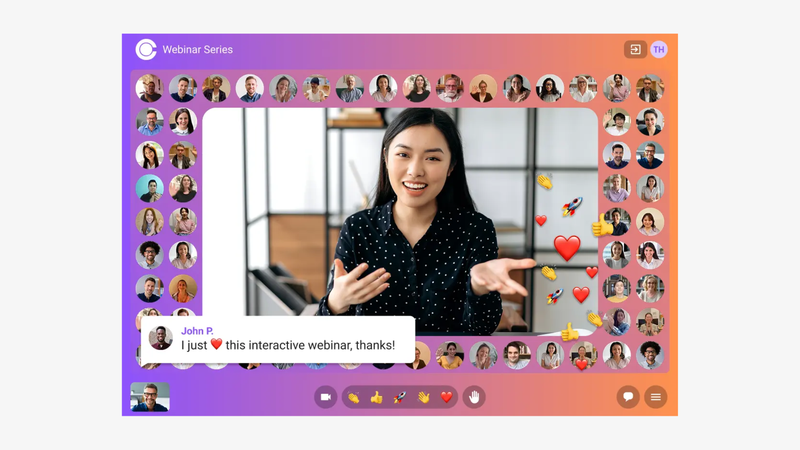
Sparkup’s browser-based webinar studio brings visual production and real-time participation together. Branded layouts help shape the broadcast, while polls displayed within the video connect audience contributions to the content on screen. Organizers can invite attendees to speak; the participant mosaic available on Events creates a shared viewing experience by bringing audience cameras together. This suits product launches, training, demonstrations and internal communications where people should contribute throughout the session.
Sparkup is worth considering when the priority is a polished video experience that remains straightforward to produce, with detailed insight into audience engagement. Demio also offers interaction and invitations on stage, so compare how the tools work together in your actual event rather than treating a feature checklist as the whole experience.
The distinction is the combination of production and participation. Demio also supports audience contributions, so the choice should come down to the experience your team wants to produce.
Key features:
- Production studio operated from a browser.
- Custom video layouts and branded overlays.
- Registration pages with customizable forms.
- Branded reminder and follow-up emails.
- Polls displayed within the video experience.
- Audience chat and question management.
- Invitations for attendees to join the stage.
- Participant camera mosaic, available on Events and higher plans.
- Webinar recordings and replays.
- Participation and engagement analytics.
Best for: Marketing and communications teams that want polished live events, real-time participation and detailed audience engagement insights.
Strengths: Studio-quality video, accessible browser-based production, interactions within the video and detailed engagement analytics.
Considerations: The participant mosaic is available on Events. If automated sales campaigns are the main requirement, compare that workflow separately.
Pricing: Sparkup’s Webinar plan starts at €99/month with monthly billing, or €79/month billed annually, for 100 concurrent participants. Events starts at €159/month monthly, or €127/month billed annually, at the same capacity and includes Audience Mosaic. Subscriptions allow unlimited webinars, with simultaneous-session limits depending on the plan. A 14-day trial is available. The free plan streams to one external destination and does not host webinar audiences on Sparkup. Compare the Events price when Mosaic is essential.
Why choose it over Demio? Choose Sparkup when you want studio-quality production, visual customization and real-time participation, with detailed engagement analysis to understand the response.
2. Livestorm: Best for Enterprise Webinar Governance and Integrations
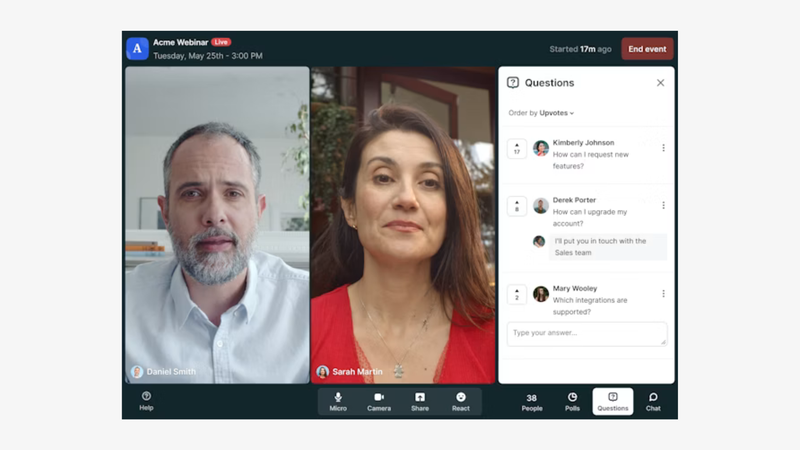
Livestorm is worth considering when webinar selection involves marketing, IT and procurement. Alongside registration, engagement and reporting, it documents security-management credentials and enterprise integrations that can matter to organizations with established approval processes.
Its browser-based workflow covers the event journey, from customized registration and email communications to audience interaction and post-event analysis. The useful question is how those capabilities fit your organization’s requirements: which CRM must receive the data, who needs access, and which security documents must a supplier provide?
Do not treat enterprise positioning as a substitute for checking the relevant offer. Integration availability varies by plan, and a supplier’s certification does not establish that another platform lacks appropriate security.
Key features:
- Customizable webinar registration pages.
- Additional fields for collecting registration data.
- Automated reminder and follow-up email sequences.
- Event-room branding controls.
- Live audience polls.
- A dedicated questions-and-answers area.
- Recordings and on-demand webinar access.
- Engagement reporting.
- CRM connections, with some integrations requiring Enterprise.
- ISO 27001-certified information-security management, as documented by Livestorm.
Best for: organizations whose decision depends on security review, governance and a specific marketing integration.
Strengths: documented security credentials and a webinar workflow connected to enterprise systems.
Considerations: Salesforce, Marketo and certain other integrations require Enterprise. Its credit model also needs careful budgeting: unlimited events do not mean unlimited external attendance across those events.
Pricing: the 400-credit configuration displays €2.50 per attendee, equivalent to €1,000 for that yearly pack when calculated from the displayed rate. Each external attendee uses one credit per session attended. Returning for another session uses another credit; live attendance and replay viewing of the same session count once. Internal team members do not consume credits. Events are unlimited, and Enterprise uses custom pricing. Check the rate for your actual credit pack rather than extrapolating from this configuration.
Why choose it over Demio? Choose Livestorm when its documented governance and required enterprise integrations are a better match for your organization’s selection criteria.
3. WebinarJam: Best for Sales-Focused Webinar Presentations
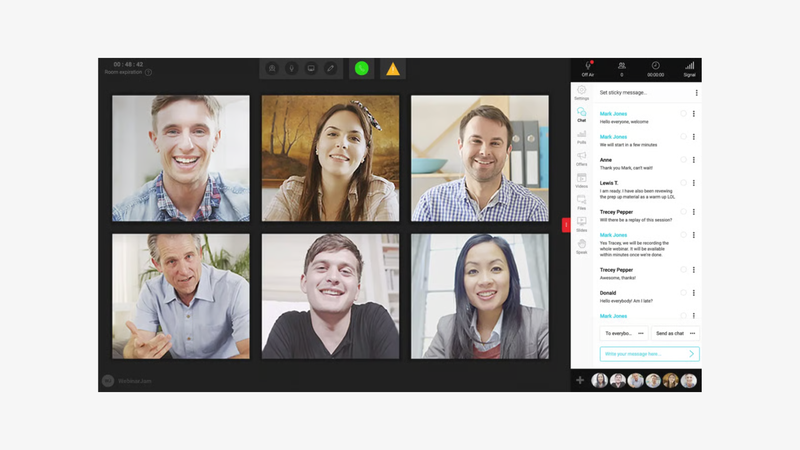
WebinarJam is aimed at businesses using a webinar to present an offer and move an audience toward a purchase. Its combination of registration tools, reminders, offer displays and presentation features makes it a candidate for coaching programs, course launches and other sales presentations.
That does not mean Demio cannot support conversion: it also provides calls to action and engagement tools. The practical comparison is how each platform supports your presentation, offer timing, audience size and follow-up process.
For repeat campaigns, the distinction between live and automated delivery is useful. WebinarJam handles the live session, while its companion EverWebinar supports scheduled evergreen delivery. Current packages include EverWebinar from Basic upward, so compare the bundle you would actually buy.
Key features:
- Customizable registration-page templates.
- Email and SMS communications.
- Real-time audience chat.
- Polls and surveys.
- Offer displays during the presentation.
- An on-screen whiteboard.
- Playback of prerecorded video during live sessions.
- Custom presentation backgrounds.
- Broadcasting to Facebook and YouTube.
- Attendee spotlight from the Basic plan upward.
Best for: creators, coaches and businesses presenting products or services through webinars.
Strengths: a sales-oriented presentation workflow and a bundled evergreen option on higher plans.
Considerations: Starter has a one-hour session limit and does not include attendee spotlight or the EverWebinar bundle. Evaluate whether its selling tools fit your event rather than selecting it solely on entry price.
Pricing: Starter costs $49/month with monthly billing, or $39/month billed annually, for 100 attendees, one host and sessions up to one hour. Basic costs $99/month monthly, or $79/month billed annually, for 500 attendees, two hosts and two-hour sessions. Both allow unlimited webinars. EverWebinar is included with Basic, Professional and Enterprise, according to the current package footnote. A separate advertised 14-day trial offer costs $1; confirm the available trial route before signing up.
Why choose it over Demio? Choose WebinarJam when its sales-presentation tools and audience-capacity packages fit your selling format, with Basic adding the evergreen companion product.
4. EasyWebinar: Best for Evergreen Funnels With Integrated Follow-Up
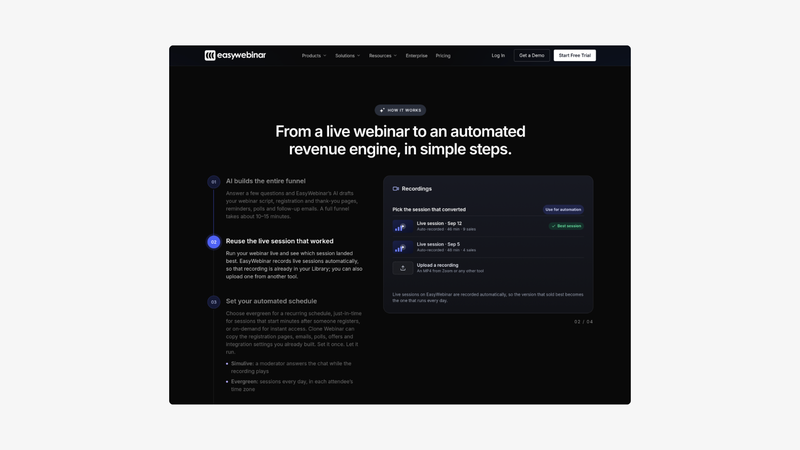
EasyWebinar is relevant when the webinar is one step in a repeatable sales or lead-generation campaign. Its higher plans bring together automated delivery, CRM follow-up and checkout, reducing the number of separate steps a team needs to coordinate.
The difference from Demio is not simply the presence of automated webinars. Both products support automated formats. EasyWebinar’s appeal is the particular combination of evergreen sessions, behavior-based sequences and selling tools within the same product.
A team running a recurring demonstration can assess the full path: registration, viewing, a purchase or contact action, and the follow-up triggered afterward. Existing CRM users should check native connector availability before deciding that the bundled CRM is useful for their own setup.
Key features:
- Live webinar delivery from Launch.
- Automated and evergreen sessions from Growth.
- Registration and thank-you pages.
- Recording and replay delivery.
- An AI campaign builder with usage allowances.
- EasyCRM contact and lead management from Growth.
- Behavior-based follow-up sequences from Growth.
- In-webinar checkout from Growth.
- EasyCast multistreaming from Growth.
- Native HubSpot and Salesforce Pardot synchronization from Pro.
Best for: teams building recurring automated webinar campaigns with integrated sales follow-up.
Strengths: automation, CRM and checkout available together on Growth and higher plans.
Considerations: Launch does not include automated delivery, while native HubSpot and Pardot synchronization requires Pro. The published total-webinar allowances also need to be matched to your campaign structure.
Pricing: Launch starts at $44/month with monthly billing for 50 live attendees. Growth starts at $116/month for 200 live attendees and includes automated formats; Pro costs $198/month for 500. The comparison grid lists total-webinar allowances of five, ten and fifteen respectively. Confirm how those allowances apply to your account rather than interpreting them as monthly live-session quotas. A standard seven-day trial is advertised. Annual discounts and temporary offers have separate conditions and should be compared against recurring prices.
Why choose it over Demio? Choose EasyWebinar when combining evergreen delivery, CRM follow-up and checkout is more valuable to your team than a focused webinar workflow.
5. Zoom Webinars: Best for Large-Audience Webinars in the Zoom Ecosystem
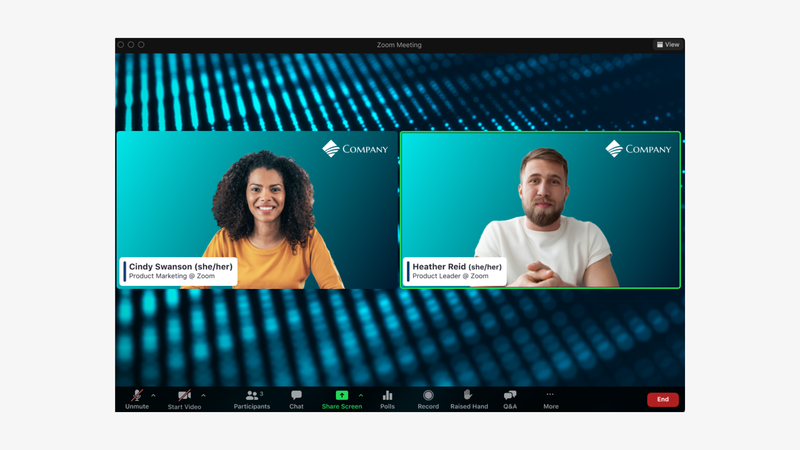
Zoom Webinars is a natural shortlist option for organizations already working with Zoom and planning structured broadcasts to larger audiences. It separates panelists from attendees and combines webinar-specific registration, interaction and reporting with familiar account administration.
There are distinct products to evaluate. Standard Webinars covers the core broadcast workflow. Webinars Plus adds production and delivery capabilities such as private backstage coordination and simulive sessions, which use prerecorded material in a scheduled event.
The decision therefore depends on both capacity and production needs. Familiarity can help a team get started, but it does not remove the need to rehearse the webinar controls, confirm attendee access and identify the exact license required for the planned experience.
Key features:
- Webinar registration pages.
- Branded confirmation and reminder emails.
- Audience chat.
- Polls and quizzes.
- Moderated audience questions.
- Panelist invitation and management.
- Recordings with eligible smart-chapter features.
- Webinar performance reports.
- CRM integrations with connector configuration.
- Simulive delivery and backstage coordination on Webinars Plus.
Best for: organizations that prioritize audience capacity and alignment with their existing Zoom environment.
Strengths: tiered broadcast capacity and a choice between standard webinars and a more advanced production offering.
Considerations: do not assume Plus features are included in standard Webinars. Confirm account eligibility and any additional base-license cost before comparing the total with a standalone webinar subscription.
Pricing: the official plan cards list Webinars at $89/month with monthly billing or $66.67/month billed annually, in USD. The product page describes the entry offer for up to 500 attendees. Webinars Plus is listed at $99/month monthly or $82.50/month billed annually. These are displayed monthly equivalents, not a confirmed annual invoice total. Eligible account and webinar-license requirements apply; check the full purchase configuration, particularly if your organization does not already have the necessary Zoom account.
Why choose it over Demio? Choose Zoom Webinars when audience scale and continuity with your Zoom environment are your main priorities, after confirming the complete licensing cost.
6. WebinarNinja: Best for a Bundled Webinar Toolkit for Small Teams
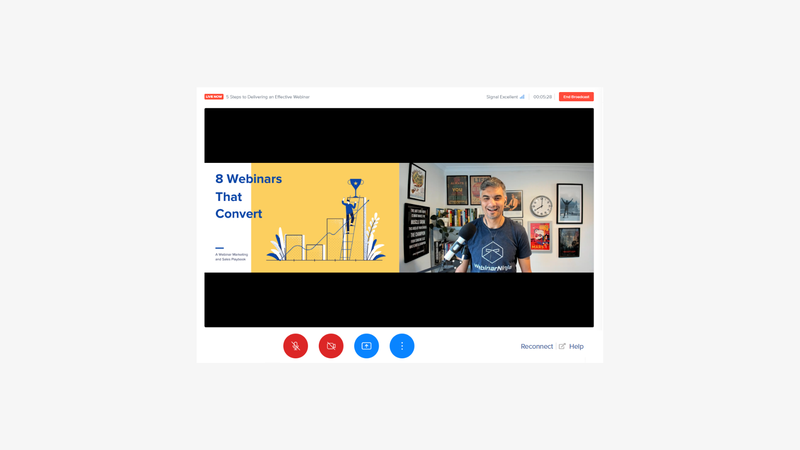
ProProfs WebinarNinja offers a broad webinar toolkit under an advertised all-feature bundle. For a small team, the appeal is having live, automated and hybrid formats available without choosing a separate product for every delivery method.
That is a useful packaging difference to investigate, rather than evidence that the software is automatically easier than Demio. Run through the tasks your team repeats: creating an event, inviting a presenter, rehearsing, delivering the session and making a recording available afterward.
The participant allowance remains an important part of the decision. Unlimited webinars and registrations do not mean that an unlimited audience can join a session. Compare the configured capacity and actual subscription total before treating a per-attendee promotional figure as your budget.
Key features:
- Webinar landing pages and registration forms.
- Automated emails and attendee broadcasts.
- Live webinar hosting.
- Automated webinar delivery.
- Series and hybrid event formats.
- Screen sharing.
- Audience chat.
- Question-and-answer interaction.
- Audience polls.
- Automatic recording and replay access.
Best for: small teams seeking multiple webinar formats within one advertised feature bundle.
Strengths: bundled live, automated and hybrid formats with unlimited webinar events.
Considerations: confirm the participant allowance, minimum purchase and billing conditions. The promotional rate below is time-limited and should not be treated as a permanent entry price.
Pricing: On November 18, 2026, the annual-billing page advertised a promotional rate of $0.30 per attendee per month, or $3.60 per attendee billed annually. The subscription total depends on the attendee capacity selected at purchase and any minimum purchase requirements. Unlimited webinars, registrations and replays and a 14-day trial are advertised. Confirm the current promotion, capacity and renewal terms before purchasing.
Why choose it over Demio? Choose WebinarNinja if its bundled formats fit your workflow and the confirmed participant allowance gives you an appropriate total subscription cost.
7. GoTo Webinar: Best for Structured Training and Departmental Webinars
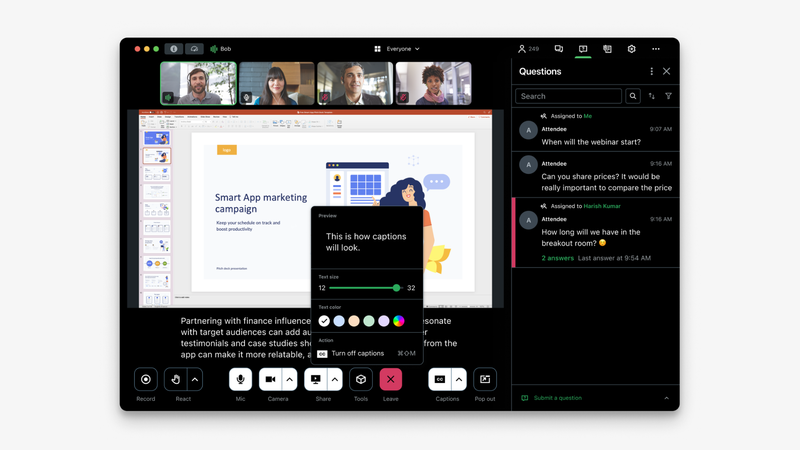
GoTo Webinar is a candidate for departments running recurring presentations, training sessions and town halls. Its current lineup separates an entry webinar package from higher offers that add branding, cloud recording, simulive delivery and breakout rooms.
Those differences matter when the event involves more than a presentation followed by questions. A training team may need smaller discussion groups, a branded participant experience or a route to certified training. Compare the relevant package against Demio rather than assuming that every training-related capability is included in the entry subscription.
The strongest reason to choose GoTo is a match with a defined departmental workflow. A longstanding product name alone is not proof of better reliability, simpler operation or a more effective learning experience.
Key features:
- Scheduling for individual events and series.
- Custom registration forms.
- Automated reminders and follow-ups from Reach.
- Live polls from Reach.
- Audience Q&A from Reach.
- Reporting and analytics from Reach.
- Custom branding and URLs from Elevate.
- Cloud recording from Elevate.
- Simulive events listed in Elevate.
- Breakout rooms from Elevate.
Best for: departments organizing structured training, presentations and company events.
Strengths: a structured event workflow with collaboration and training options on higher tiers.
Considerations: cloud recording, branding and breakout rooms are promoted under Elevate; paid events and certified training appear under Complete. Budget for the package that includes the required workflow.
Pricing: with EUR selected, Reach is displayed at €59/month with monthly billing or €50/month billed annually, for one organizer and up to 500 participants. Elevate costs €110/month monthly or €88/month billed annually and increases capacity to 1,000 participants. It adds cloud recording, branded webinars, simulive, transcripts and breakout rooms. Complete is a tailored package for requirements such as paid events and certified training. Confirm local currency, taxes, add-ons and the final subscription total before purchase.
Why choose it over Demio? Choose GoTo Webinar when departmental training, breakout rooms or certified-training requirements justify the relevant higher-tier package.
How to Choose the Right Demio Alternative
Audience Capacity and Session Duration
Start with the number of people who will attend at the same time, rather than the total number of registrations. A campaign with 1,000 registrants and 100 live viewers has a different capacity requirement from an event expecting all 1,000 to join.
Then check duration. A 45-minute product presentation and a half-day training session cannot necessarily use the same entry plan. Leave room for questions, late starts and technical recovery instead of choosing a limit that exactly matches your planned agenda.
Live Production and Participation
Write a short rehearsal agenda before requesting a demo. Include a speaker change, a screen share, a poll, an audience question and any prerecorded material you plan to use.
If the audience will appear on camera, test that transition too. The presence of an invitation feature does not tell you how it fits into the broadcast. For a more produced format, evaluate layouts, overlays, backstage coordination and the work required from the person running the session.
Automation, CRM and Follow-Up
Identify what happens after an attendee watches, clicks or asks a question. Decide whether your existing CRM should manage follow-up or whether a bundled tool is useful.
Check the exact native integration and subscription tier. A logo on an integration page does not establish that every field, event type or automation is supported. Ask how contacts, consent information and engagement activity move between the products you actually use.
Total Cost and Billing Commitments
Use a consistent scenario: ten one-hour webinars per year, 100 external attendees at each, one active host and no simultaneous events. That means 100 concurrent participants but 1,000 person-session attendances over the year.
A capacity-based plan and an attendance-credit pack handle that example differently. Under Livestorm’s published rules, someone returning for another session consumes another credit. Sparkup instead bases the selected webinar capacity on people connected simultaneously, with unlimited webinar sessions.
Compare equivalent capacity, functions and contract length. Demio Starter and EasyWebinar Launch have 50-attendee entry configurations, so their lowest prices do not cover this example. Keep EUR and USD amounts separate unless you explicitly calculate a dated currency conversion.
For a broader shortlist beyond this Demio-focused comparison, see our guide to the best webinar platforms.
Verdict: Which Demio Alternative Should You Choose?
Keep Demio on the shortlist if its marketing-webinar workflow already matches your needs. Switching makes sense when another platform improves a specific part of the program.
Sparkup suits teams that want more polished webinars, real-time interaction and detailed audience engagement analysis. Livestorm suits governance-led evaluations. WebinarJam and EasyWebinar serve different sales and automation workflows; Zoom Webinars is relevant to larger audiences and existing Zoom users. WebinarNinja bundles several webinar formats, while GoTo Webinar provides options for structured training.
try Sparkup for 14 days and rehearse your own format. Include Events in the evaluation if Audience Mosaic is essential.
FAQ
What Is the Best Demio Alternative for Interactive Live Webinars?
Sparkup combines a browser-based webinar studio, polls within the video, invitations for attendees to speak and detailed engagement analytics. The participant mosaic is available on Events. Rehearse your actual format when comparing it with Demio: evaluate the visual result and how easily participants can contribute.
Which Demio Alternatives Support Automated Webinars?
EasyWebinar includes automated and evergreen delivery from Growth. WebinarNinja advertises automated formats within its feature bundle. WebinarJam’s current Basic and higher packages include its EverWebinar companion product. Zoom Webinars Plus and GoTo Elevate also advertise simulive delivery, although a scheduled prerecorded event is not automatically equivalent to an evergreen marketing funnel.
Is There a Free Alternative to Demio?
First distinguish an ongoing free plan from a time-limited trial. Sparkup’s free offer streams to one external destination; it does not host a webinar audience on Sparkup. Its paid plans have a 14-day trial. Other providers also advertise trials with different limits. Check audience capacity, session duration, recording and automation before treating a free offer as a replacement.
Which Pricing Model Works Best for Frequent Webinars?
Concurrent capacity with unlimited sessions, as on Sparkup, can make a program easier to forecast when audiences remain a similar size. A credit model such as Livestorm’s can suit a different pattern, but attendance at each new session consumes credits. Calculate annual participation, hosts, duration and essential features rather than relying on an entry price.
Can I Move My Webinar Program From Demio to Another Platform?
Plan the move around data, content and participant access. Check contact exports, consent records, CRM connections, registration links and replay availability before canceling the existing service. Build and rehearse one event on the new platform, then test registration and follow-up. Do not assume that recordings, automations or historical engagement data transfer automatically between products.